Yoghurt without fail

Keeping yoghurt warm in a pot at the edge of the woodstove, one of the tricks I’ll discuss in this post.

Yoghurt with a taste similar to what we might find in a grocery shop was something I gave up on for a long time. I made only room temperature viili for years, thinking that a good Greek or Bulgarian style of yoghurt was beyond me. At some point I decided I preferred the taste of this style of yoghurt enough to find ways to make it work, and now I make yoghurts far tastier and healthier than anything I can find for sale. In this article you’ll find my recipe, along with extra tips to make really good yoghurt every time.

How to make yoghurt

Heat milk in a saucepan until it reaches 82ºC (180ºF) or higher, hold it at or above that temperature for half an hour, if possible, and then let it cool to around 40ºC (104ºF). 

Pour into jars, then stir through around 5 tablespoons (75ml) of yoghurt for every quart (litre) of milk.

Keep your culturing yoghurt at 40ºC (104ºF) for the next 6 hours or more (I find that 12 to 18 hours is best).

How to keep yoghurt warm during culturing

A couple of ways to keep yoghurt warm are: 

• fermenting it in an insulated food jar such as a thermos.

• surrounding a normal jar with hot water in an esky (cooler) or on the edge of a woodstove dying down for the night.

I use the latter method, as it means I don’t have to mess around with transferring yoghurt from one jar to another once it’s ready – I culture it in the same jar that I use for storage.

There are special non-electric insulated yoghurt fermenters available, where you fill it with hot water, place your jar of yoghurt inside, seal, and leave to culture, but I find the size of these limiting, as they will only hold a specific size of jar, and from my experience they aren’t that great at keeping the heat in.

There are also electrical gadgets, such as Instant pot and specialty yoghurt makers, but I avoid relying on electricity as much as possible so these are not things I have tried.

• In real life, the temperature does tend to drop over time, so it’s sometimes easier to start culturing it at a slightly higher temperature (up to 46ºC or 115ºF), and leave it culturing for twelve hours or more rather than six. Some of the helpful yoghurt bacteria will still be active in the lower temperatures, and the heat-loving bacteria will still have some time to grow during the earlier, warmer stages of culturing.

In winter I leave my yoghurt jar overnight in a pot of warm water on the edge of the woodstove as it cools down, and then refill the pot with hot tap water in the morning to give it more time to culture at high temperatures. I find that yoghurt tastes the best after around 18 hours of culturing in this way during winter.

Tips for making thick yoghurt

• Experiment with using milk from different animals or different sources. One of the goats here gives very creamy milk that makes excellent thick yoghurt, my other goats give milk that makes a thinner yoghurt. If I were mixing all the milk together I would not have noticed this. Full fat cows milk generally makes lovely thick yoghurt, and milk from a Jersey cow or other cow that gives extra creamy milk will make even thicker, lovelier yoghurt.

• Winter milk makes thicker yoghurt than summer milk. Sometimes it helps to just accept that winter is the time for thick yoghurt and in summer you might want to stain it through cheesecloth if you want it to be thicker.

• Yoghurt will be thicker if it is first heated above 82ºC (180ºF), and then left to cool to the culturing temperature. If you can heat it up slowly, or hold it at the goal temperature for half an hour, this will help to create thicker yoghurt. The high temperature changes the protein structures in the milk, to help create a thicker yoghurt.

• Allowing the milk to cool down and then reheating to 82ºC also can help make for thicker yoghurt.

• You can evaporate some of the liquid out of the milk, by leaving the pot on the heat with the lid off once it’s reached temperature – just observe the level of the milk you start off with, and then remove and allow the pot to cool once it’s reduced by ¼ to ½.

• For thick Greek yoghurt, allow your yoghurt to continue culturing at warm room temperature until the whey begins to separate. Pour it into cheesecloth and allow the curds to continue dripping whey until it’s as thick as you’d like it to be, anywhere between two and twelve hours.

Tips for reliable yoghurt culturing

• Yoghurt is best made at least once per week, to keep the culture fresh. It is worth keeping a small amount of yoghurt tucked away in the freezer, just in case your yoghurt gets contaminated or abandoned.

• Cultures that contain acidophilus seem to be more reliable home kitchen conditions

• If in doubt, add more yoghurt to start it off, rather than less. Some recipes advise using only two tablespoons for a litre (quart) of milk, but I always use 5 tablespoons and it doesn’t hurt it, it just makes the milk get colonised more quickly while the temperature is warm.

• To keep your yoghurt culture as active and pure as possible and avoid having to buy new culture, it’s a good idea to keep everything as sterile as possible: Heat and cool your milk in a pot with the lid on, heat-sterilise your jars, don’t leave them open to the air any longer than you have to, and be very careful with any jar of yoghurt that you’ll be using as a starter for your next batch – pour the yoghurt out rather than reaching in with a spoon (unless the spoon is heat sterilised). For even better results, make an extra smaller jar of yoghurt that you can use as your culture, and then it doesn’t matter what happens to your jar of eating yoghurt.
Enter your email address here to get new recipes and blog posts from The Nourishing Hearthfire.

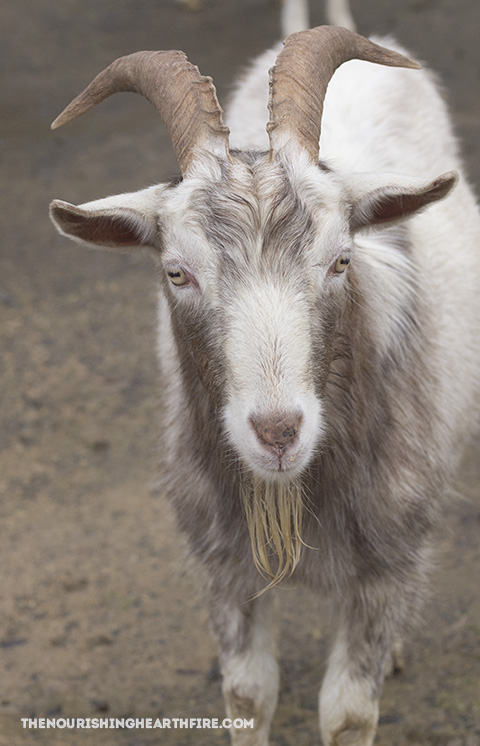
Young Liflin

OLYMPUS DIGITAL CAMERA

Note: If you’d like to learn more about how and why I keep dairy goats, I’ve had a couple of guest posts published recently on Practical Self Reliance, and Nourishing Days. These blogs have a lot of other good stuff to read about too.

Liflin was born here, he’s the son of Snowy and Ned, and the cute baby goat you can see in my midsummer post. Last year we had high hopes for him, and he certainly tried his best, but he was probably too small or young to get our does pregnant.

This year he is bigger and stinkier, and there’s no mistaking that he is no longer a cute little goat kid, but a big stinky billy goat. I don’t find the smell that bad – there is something endearing about it, as I affectionately give him a scratch between the horns while calling him big stinky billy goat. Spending a lot of time with goats, I don’t really mind it, but when I first smelled a buck, it definitely was very strong!

Towards the end of April I noticed muddy hoof prints on Sunshine’s back. Soon after, other does began to go into heat, and all of a sudden it seems as though they were all covered with hoof prints.

These days Liflin is still stinky, and a bit frustrated, as none of the does are interested in him anymore. I hope it is for the right reason, and that we’ll see lots of babies and milk in the springtime.

I look for every sign of pregnancy, and am hopeful, but still nervous. Only two does are in milk now, and their supply has really slowed down. Geraldine will pick back up in springtime, whether she’s pregnant or not, but the others may not.

I dream of a summer and autumn ahead where I make one or two hard cheeses a week and store them away for the winter and spring. I dream of regularly making pizza from my own cheese, of having chévre for barter and gifts. I dream of my six does being in milk during the winter, and giving us enough milk to drink, and make yoghurt, and the odd batch of chévre. The thought of this abundance from our land is beautiful, but Liflin is untested, I don’t know whether it will happen or not…

I wonder when in homesteading things become ‘real’. I visit museums and historical sites about our pioneer ancestors and imagine what life was like for them – dropped off on our strange island with limited supplies, and no choice but to survive on the land and make the best of it that they could. There was no option of looking on Gumtree for another goat in milk, no option of buying someone else’s cheese, they had to make do with what they had.

I wonder if this was a source of worry for them, or if they just faced challenges, accepted their situation, and made the best of it, maybe drinking less milk some years, more milk other years, and finding other sources of food. It’s hard to know the answer to this. Everyone I speak to from older generations seems to avoid the idea of working to directly produce their own food as if it were a bad thing, while viewing a sedentary life in an office as an interchangable cog as something worthwhile to do in life. Yes, it can be hard to worry about the animals and our staple foods for the year ahead, but I find fulfilment in being connected to this.

Enter your email address here to get new recipes and blog posts from The Nourishing Hearthfire.

Backyard Dairy Goats: A Natural Approach to Keeping Goats in any Yard

I am excited to announce my new book Backyard Dairy Goats: A Natural Approach to Keeping Goats in any Yard

You can read more about it by clicking here.

cover-small

To help cut out the middlemen involved in publishing I’ve started a Kickstarter campaign for the book. This means that if you’d like to pre-order a copy for less than the future price, you can easily do this on Kickstarter. You’ll get bonus mini-ebooks too, and the option of other exciting rewards like cheesemaking kits, tree planting, and getting your name on the acknowledgements page of my book.

The campaign is only on for 20 days, so please click here if you’d like to read more about it and be a part of this unique and independent new book.

Backyard Dairy Goats is a book focusing on raising dairy goats in a way that respects their nature, on any amount of land. My aim with this book is to make backyard dairying achievable for anyone.

Most books about goats focus on keeping them on a larger scale, and don’t address many issues for those who just want some milk from a couple of goats in the backyard. Topics covered include:

•Natural goat health, how to prevent and fix most issues without a vet.

•Small batch cheesemaking.

•Everything you need to know about goats – their behaviour, how to feed them, handle them, what they need to thrive, and so on.

What this book is about:

•Caring for goats in a way that respects their goatness.

•Getting dairy goats now, wherever you are. It doesn’t have to be a dream that may happen one day in the distant future, it could happen now, and this book will show you how.

•Learning from observation, and goat behaviour in the wild to provide the right foods for goats to thrive.

•A permaculture approach, looking at the whole backyard ecosystem and the many interactions between goats, animals, garden, people, and trees.

•Cheesemaking and home dairying without artificial weird stuff.

Goat dairy as a homemade staple food, for health, survival and self reliance. Recipes included.

Not just for backyards

This book is relevant for larger bits of land as well, especially in the early years while you’re waiting for perennials to grow or waiting to build more fences. Goat milk provides an instant harvest, with a minimal amount of brought-in feed, using smaller amounts of land and food than cows, while providing manure for the garden.

Click here if you’d like to learn more.

Perfection

_6113221-480.jpg

I am not that great at describing foods. I sometimes laugh at the descriptions on the back of wine bottles, and at the obsessions that plague the cosmopolitan boomer-inspired worlds of recipes and restaurants, when to me there is just nothing like simple foods created traditionally, and there’s not much to say except ‘perfect’.

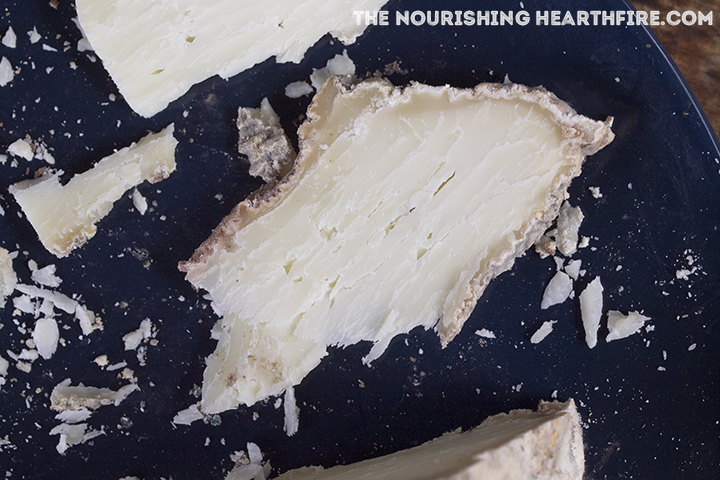
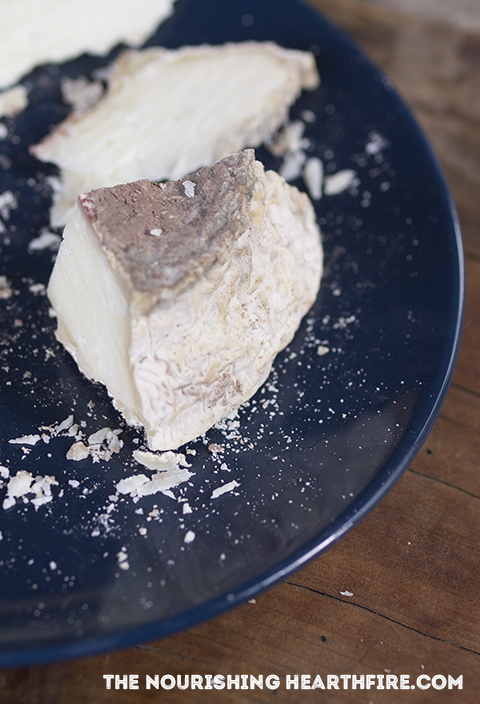
This cheese deserves praise though. I will post pictures of it and tell its story.

_6113226-480.jpg

This cheese was the last cheese I made this year, towards the end of March when I switched back to once a day milking. I’ve had a few hard cheesemaking fails this season due to my rennet being old and stored badly, but there is just nothing like homemade hard cheese, raw and full of flavour from wild cultures, so I persist in trying them every so often. This one used a ‘washed curd’ technique that gouda and havarti use, I used some of my homemade viili yoghurt as starter, and I probably made it on a fruit day in the biodynamic calendar. I used an 800g cheese mould, using 5-6 litres of goats milk.

Lately my land and house have been wanting to grow camembert-style rinds. As this cheese became soft-looking as it aged, and the sides of the rind ‘splooged’ (for lack of a technical word) I noticed a beautiful white rind forming on the splooged bits. At some point it stabilised, but I eyed this off every time I tended to the cheeses, wondering if it would be similar to camembert when I cut it open.

_6113223-480.jpg

We cut it open the other night, it was like no other cheese I’ve had. Cheese perfection that doesn’t fit into any little cheese category in a book. This cheese can’t be replicated with packets of cultures and milk from the shop, it is just like all good foods should be, an expression of the land that makes it.

I sat it next to the ripening chorizos and saucisson secs in the larder, to spread the white bloom.

_6113232-480.jpg

Enter your email address here to get new recipes and blog posts from The Nourishing Hearthfire.

Nostalgia

OLYMPUS DIGITAL CAMERA

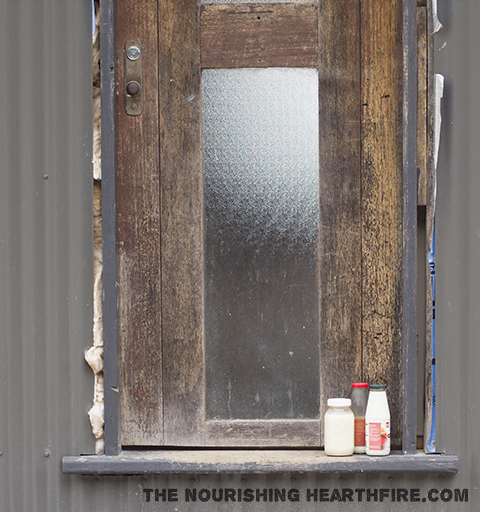
We’ve moved into our house in the forest. We haven’t built the mud room/wood storage area yet so every morning I tromp towards the door in my muddy boots and leave bottles of fresh goat milk on the doorstep before taking my boots off.

During my husband’s childhood milk was still delivered each day in glass bottles, a layer of cream would rise to the top. The bottles would be washed and returned, reused again and again. In my childhood memory is milk still being delivered, but by then it was homogenised and in plastic-lined cartons. The old system of reusing the glass bottles was not done with any thoughts of sustainability, it was just the way things were. It made sense to reuse bottles rather than throwing everything into landfill, or throwing it in the recycling pile to be melted down and turned into another single-use plastic item with the use of a lot of energy. At some point in time it became so cheap to simply make new things all the time, and it became so easy to just throw everything in landfill without a thought that the culture of reuse stopped. This happened more recently with a raw milk farm we were buying from, the farmer decided it was taking too much time to clean the bottles and started using single-use plastic bottles. No thought is given to how much time it took for the oil to form in the earth to make this plastic, how long it will take to break down in landfill, how much time it would take to create these bottles if the specialised bottle-making machines were to break down, or what the end result will be of all the tiny particles of plastic seeping into our soil and water, all that is thought of is the inconvenience of washing something versus the perception of an easy and quick solution.

One of the earliest lightbulbs ever made still functions today. The businesses that made lightbulbs quickly realised that they would make more money if their products had to be bought again and again, rather than being made to last.

The other day I saw an advertisement on an ice cream fridge for a new flavour of ice cream. I could only see half the name and thought it said “red vegetable”. The corporation had become so desperate for new and exciting things that they were now trying to make vegetable flavoured ice creams, to appeal to people seeking new things for the sake of the newness of things. It turns out it wasn’t really red vegetable flavour, but I’ll remember it because it prompted some nostalgic thoughts about the amount of foods around when we were growing up. We had treats sometimes, but it was usually in small quantities, and it usually was a particular thing or another, to be eaten as a treat, rather than eaten because it was new and we had to try it. I don’t remember there being any overweight or obese children growing up in the 80s and 90s.

Autumn leaves now drift gently down from the trees while cold winds stir the evergreens, bringing cold gusts of air while the sun radiates the last warmth of summer. Night falls earlier and earlier every day. Soon our wood stove will be ready and our nights will be warmed with fire.

OLYMPUS DIGITAL CAMERA

_4302427-480.jpg

_4302431-480.jpg