
/
/

Here is a simple recipe for a delicious crusty fresh milled flour sourdough boule baked in a dutch oven.
I really like this recipe because it’s simple to measure, there are different options for timing, flours, and shapes, and it simply tastes great! This loaf was a favourite for many of the recipe testing team for Sourdough Without Fail too.
Jump to RecipeThe dutch oven method is the closest thing we can do at home to achieve the same results that professional bakers get in a traditional wood-fired oven. By heating up the dutch oven in advance, we create a source of thermal mass, steam, and conductive heat, all at the same time.
One of the keys to getting a great rise and oven spring with fresh milled flour doughs is to have a source of steam. Using a dutch oven or bakers cloche traps the steam that comes out of the loaf as it heats up in the hot oven, keeping the crust soft, and allowing maximum dough expansion.
I find that a 5 litre (5 quart) size dutch oven is the best choice for making boules. I can use this size to either make a regular-sized sourdough boule, or a double batch boule, and it’s an excellent size to have around the house for making all kinds of soups, stews, pot roasts, bone broth, and rice. I like to use enamelled cast iron, but regular cast iron works well too.
Some bakers prefer to use a double dutch oven, combo cooker, or baker’s cloche for making boules, because you can be a bit more gentle when transferring your loaf into it. I just use the dutch ovens that are already in my home, and they work fine. If I didn’t already own a dutch oven and were choosing something new, I’d probably pick the double dutch oven.
• If your loaves are not springing up as much as you’d like in the oven, throw an ice cube in next to your loaf in the dutch oven to provide extra steam.
• If you need to bake more than one loaf, simply remove the first loaf when it’s done, put the dutch oven and lid back in the oven, and allow it to heat back up for 15 minutes before adding your second loaf in.
Join our weekly Floury Friday emails and get access to a free ebook full of fresh milled flour sourdough discard recipes – cakes, pies, cookies, crackers, pancakes, pasta, and more…

Ferment your dough for 4 to 6 hours, shape, proof for 2 to 3 hours, then bake
Ferment your dough for 4 to 6 hours, shape, proof in the fridge overnight, bake the next day.
Ferment your dough overnight below 8ºC (46ºF). Shape, proof for around 3 hours, then bake.
Make the loaf as-is, using all wheat (hard white or hard red, or a mix), emmer, or Khorasan. This loaf works beautifully with home-milled flour or store bought flour.
Replace up to 82g (2/3 cup) of the wheat flour with fresh milled rye flour.
Replace 50% of the flour with spelt, or use all spelt if you don’t mind your boule flattening out a bit in the oven
Use all einkorn flour instead of wheat, just make sure to reduce the water by 45g (3 Tbsp) per loaf.
Feel free to add your choice of fruits, nuts, and/or seeds to the dough. Olives work well too. Simply mix through around 135g of dried fruit, nuts, seeds, or olives during the last set of stretch and folds.
This dough also makes excellent baguettes! Or use it for rolls or pizza, or make a bâtard instead of a boule. This dough works well for pan loaves too.
You can also make an extra large boule by making a double batch of dough, and then shaping and baking it as a single large boule. Reduce the oven temperature to 220ºC (430ºF) and increase the baking time by 15 minutes. You’ll need a dutch oven with at least 5 litres (5 quarts) capacity for this.
Get a bowl or brotform ready to hold your dough by draping a linen tea towel or other non-fluffy towel into it, with the edges hanging over the sides. Dust the towel liberally with flour.
In the photos below, the shaping begins in the bowl, with the final tensioning happening in mid-air. You can do all the shaping in mid-air (or in the bowl) if you prefer.


A dutch oven, at least 4 quarts (4 litres in size) (5 is better)
Mixing bowl
Proofing bowl or brotform with a rounded shape, at least 2 litres (2 quarts) in size (I like to use a 3 litre (3 quart) Pyrex bowl)
Linen tea towel, or similar non-fluffy towel
100g (scant 1/2 cup) ripe fresh milled flour sourdough starter at 100% hydration
500g (3 3/4 cups + 2 Tbsp) fresh milled wheat, emmer, or Khorasan flour (or other options, see above)
400g (1 2/3 cups) water
8g (2 1/2 teaspoons) salt
Combine all the ingredients in a large mixing bowl. Mix with a spoon or your hands until no traces of flour remain.
Allow to sit for around 20 minutes, then do a series of stretch and folds.
Leave to ferment until it has increased in size somewhat and feels puffy and airy when poked – this will take around 4 hours at around 22ºC (72ºF), longer if it’s colder. Optionally do up to three more sets of stretches and folds early on in the fermentation time.
Divide the dough if you’re making more than one loaf, and shape into a boule. Place in a bowl lined with a tea towel, and leave to rise either two to three hours at room temperature, or overnight below 8ºC (46ºF).
Preheat the oven to 230ºC (450ºF) with a dutch oven (including the lid) inside it.
Once the oven and dutch oven are hot, gently invert your loaf into the dutch oven, optionally score the top of the loaf a couple of times, put the lid back on, and bake for 50 minutes in total, removing the lid after the first 20 minutes.



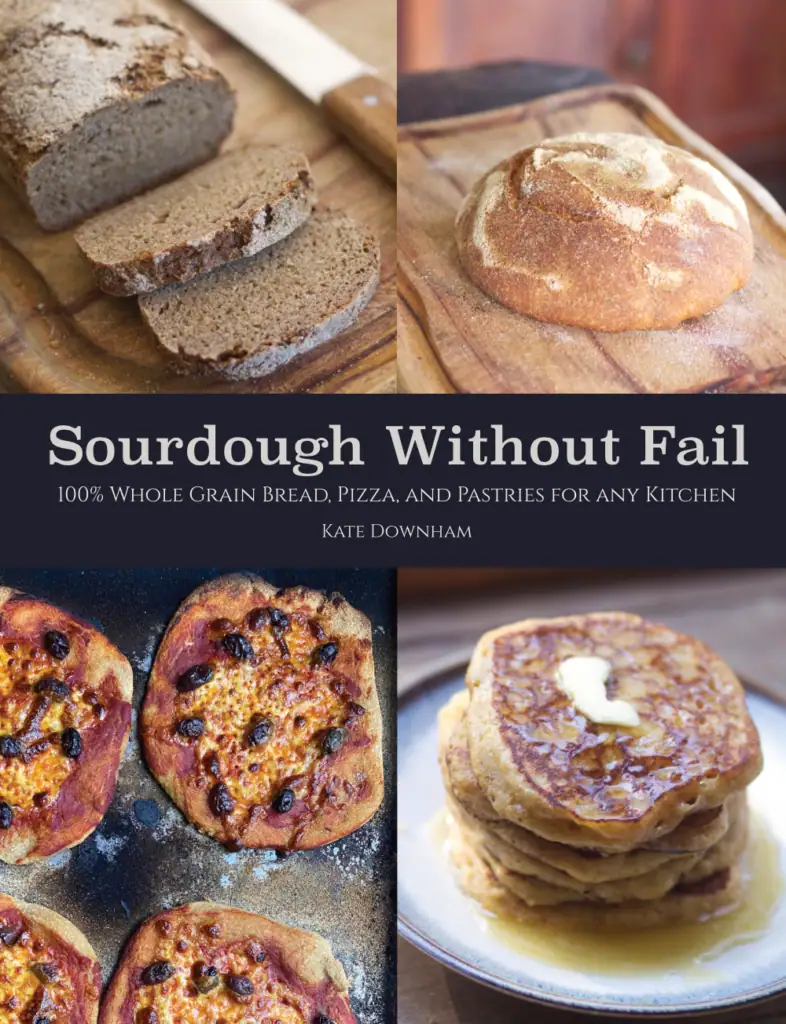
Fresh milled flour sourdough book
Baking great sourdough doesn’t have to be complicated or time-consuming. Whether you’re using fresh milled flour or store-bought flour, you can make delicious bread, pizza, and more in your own kitchen.
Sourdough Without Fail is written for real home bakers and homesteaders who want recipes and methods that work in real-life conditions.


Join The Nourishing Hearthfire for real food recipes, traditional skills, and monthly inspiration for your hearth and homestead.
We respect your inbox. Unsubscribe anytime.

Kate Downham has been growing, preserving, and cooking real food since 2007. She is the author of four books on homestead skills: A Year in an Off-Grid Kitchen, Natural Small Batch Cheesemaking, Backyard Dairy Goats, and Sourdough Without Fail.
Off-grid with her family of nine in the Tasmanian forest, Kate milks her own goats, makes all their cheese, mills all her own grain, and bakes fresh sourdough bread daily.


Simple recipe and lovely bread






The Nourishing Hearthfire is reader-supported and mostly ad-free
Leave a Reply