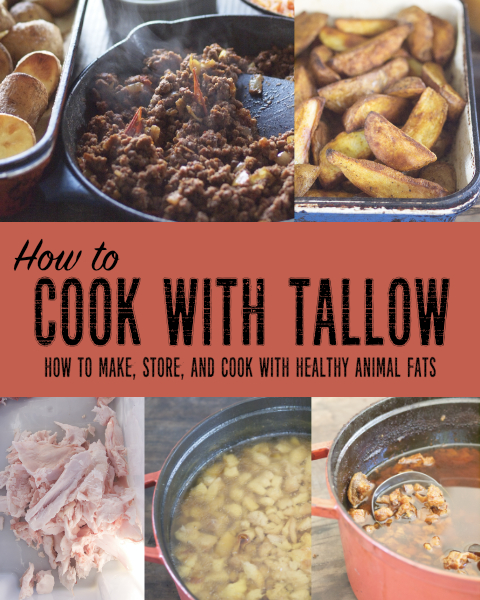
How to cook with tallow, how to render it, how to store it (and why)

Many events in recent years have caused me reflect on the expectations of the industrial food system and modern lifestyles, and how rewarding it is to return to simpler ways. Olive oil is in short supply this year, and this offers another opportunity to create better alternatives for cooking that can be produced on a homestead or by local farmers.

Most of the olive oil in supermarkets is adulterated with seed oils, so is not the healthy fat that many people imagine it to be. Real olive oil also should not be heated above 180ºC (350ºF), so it is not an ideal all-purpose cooking fat, even if it can be found.

Animal fats, such as lard and tallow, are usually local and small-scale by nature – so local that most of the time you will need to render it in your own kitchen (a simple process, see my method below). The saturated fats and cholesterol found in tallow are needed for hormone function, memory, neurological health, kidney, liver, and lung health. The healthiest fats are those from animals that are raised naturally outdoors – animals raised in this way are often raised by small farmers, so it’s possible to directly ask questions and make sure the animals aren’t being fed any weird additives and other stuff.

Most recipes I see use liquid oils such as olive oil or seed oils as the main cooking fat. I can understand the temptation for food writers to use ingredients that people are familiar with and can find in a supermarket, and to not clutter ingredients lists with a bunch of alternatives, but animal fats have so many benefits and can be used for all kinds of cooking. To create a resilient local foods system for real food sovereignty I think it’s essential to choose local animal fats as a staple cooking fat, which is why in my cookbook the recipes use lard and tallow.

Most people are used to cooking with liquid oils these days, but it can be just as easy to cook using tallow, lard, and other animal fats.

How to cook anything in tallow and lard

To cook anything in solid fats, we first need to turn it into a liquid fat by melting. This is easily done by heating it directly in the roasting dish if it’s made from cast iron, enamelled cast iron, enamelled steel, or stainless steel. Simply put your roasting dish in the hot oven or on a hot stovetop, with as much tallow as you think you’ll be using, and allow it to melt until it’s a hot liquid. This doesn’t take long. Add your vegetables, toss them around in the hot fat with a wooden spatula to coat them, sprinkle with salt, and bake. For meat, just place it on the hot fat and cook it – I get beautiful steaks and burgers every time by making sure my pan and fat are extra hot (a drop of water should violently jump up when splashed on it) – allow the meat to fully sear on one side before turning it.

If you use glass or ceramic pans for roasting, to avoid cracking them with sudden temperature changes, don’t preheat the pan, just melt the fat in a saucepan, mix the vegetables in the fat, and then add it to your pan.

Sautéing, stir frying, and deep frying are even easier – just heat your tallow in the pan and cook in it.

How to make your tallow or lard

Finding ready-made tallow and lard from healthy sources is not often possible, but making your own is really simple and affordable. If you buy beef by the quarter, half, or whole, you can probably get tallow for free just by asking the farmer or butcher in advance.

Lard and tallow either come as leaf lard or suet, or as offcut fat. Leaf lard and suet are pure fats from around the organ meats, these have a very mild flavour and can even be used in pastries. Offcut fat usually contains small amounts of meat, so can have a stronger flavour and may benefit from a bit of trimming, but is still good for most uses in the kitchen.
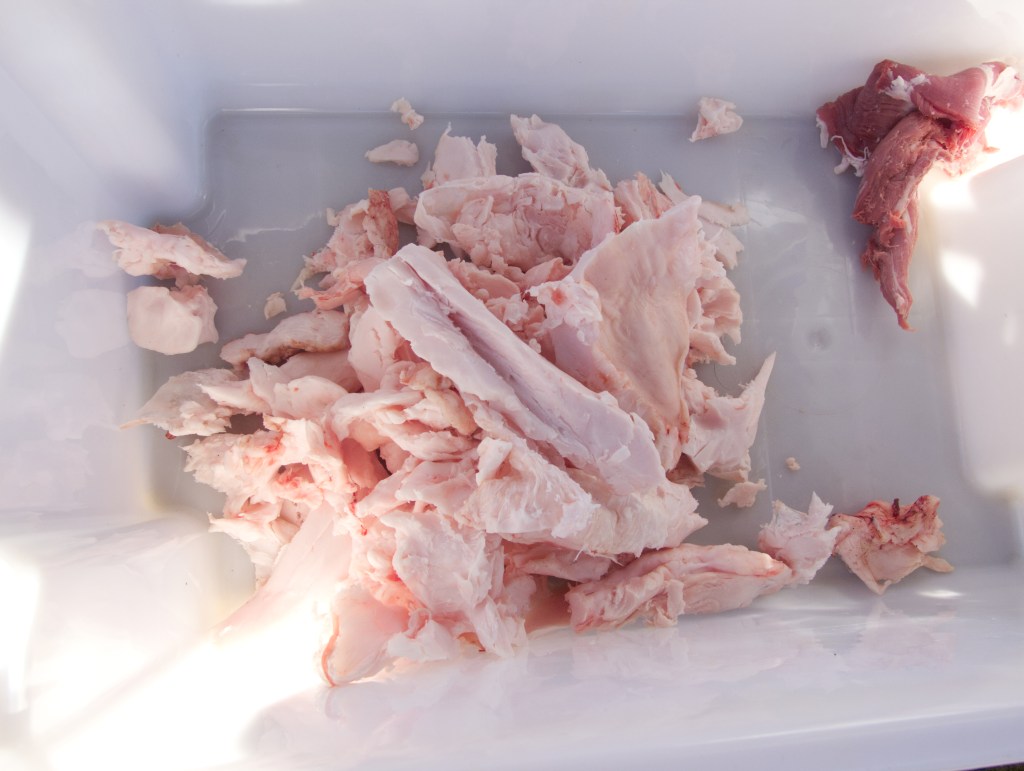
Leaf lard from homegrown pigs

To render fats, first chop it into small pieces and place in a heavy pot with a lid or in a slow cooker, Add just enough water to cover the base of the pot, then stir to coat the fat in the water. Bring the pot to the boil with the lid on, stir, and the reduce the heat to a simmer. Allow the fat to slowly render in the pot for as long as it takes, sometimes just a couple of hours, other times for a larger batch it can sometimes take a day or two. Stir the fat every now and then as it renders.

If you’re concerned with water remaining in the tallow and impacting its storage life, allow the pot to render with the lid off over a gentle heat for some of the rendering time.

As the fat renders, there will be more and more liquid fat, and the pieces of solids will shrink, and sometimes go crispy. Once all the solids are crispy (or at least empty-looking and light in weight), allow the bubbling fat to cool slightly, before carefully straining through cheesecloth or a mesh sieve into warm heat-sterilised jars. Put the lids on tightly, and for the best keeping qualities, flip the jar over onto the lid as you would for old-fashioned jam, and then flip back onto the upright side and allow to cool before storing. 

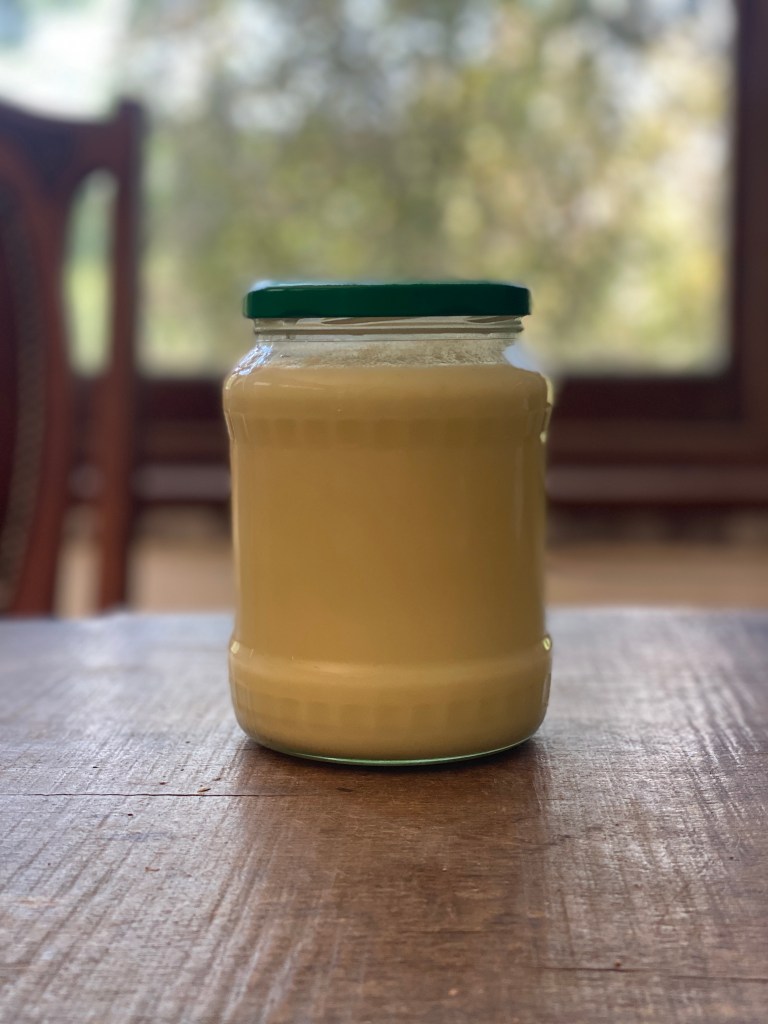
The storage life of lard and tallow depends on how well it was strained, if all the water evaporated as it cooked, and how clean the jars are. The temperature you store the lard in will also impact the storage life – the ideal situation is larder or root cellar temperatures of around 10ºC (50ºF) or lower, but room temperature is also often fine. Lard and tallow can also be stored in a fridge or freezer. 

1. Offcut beef tallow in the early stages of rendering. The fat has started to come out of the solids, but the solids still feel heavy, with plenty more fat ready to render out. Fat can be skimmed off the top at this stage, as needed, or the whole batch can be rendered, strained, and put into jars in one go. 
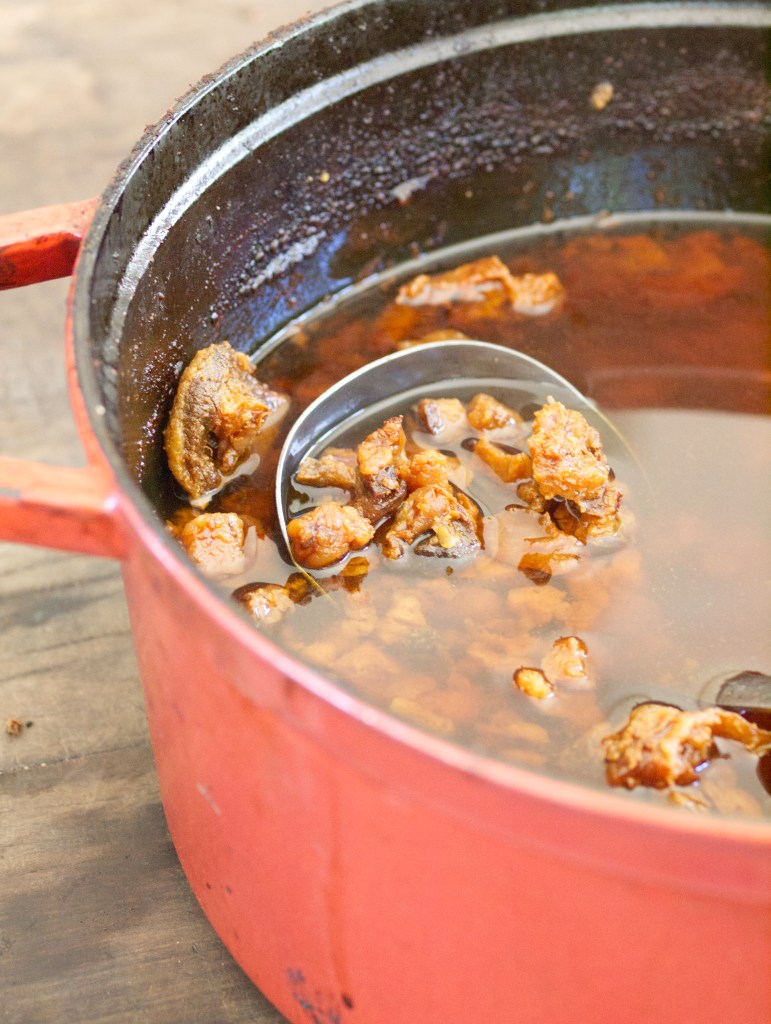
2. Rendering is complete. The solids are crisp and airy, with all fat rendered out into liquid. It’s now ready to be strained in jars. The leftover crispy bits can be fed to chickens. 

The brown colour of the fat means that this batch got a little overcooked. When this happens, it’s still fine for use as a cooking fat, and has a nice toasted flavour, but it won’t be as good in a pie crust or anywhere else that needs a neutral-tasting fat. 

To make the best possible purified tallow for the longest storage life at room temperature

Instead of straining the fat directly into jars, pour it into a large stainless steel bowl. Allow the fat to cool completely in the bowl until it is solid, then gently heat the bottom of the bowl, flip the solid mass of fat out into a new pot or bowl, so that the rounded side is now up, and scrape off any impurities that have gathered on the bottom. Melt the fat until hot again, and pour into warm jars, as you normally would. You can also do this refining process a second time.
Enter your email address here to get new recipes and blog posts from The Nourishing Hearthfire.

Homemade French Onion Soup

The secret to a great French onion soup is the quality of the bone broth – it should be lovingly made at home from beef bones which have been first roasted to create extra flavour before being slowly simmered for 24 hours or longer, or until the broth is so infused with flavour and minerals that it smells delicious on its own when hot, and sets like a jelly when cold.

Allowing plenty of time for the onions to slowly caramelise also helps to bring out the best of a few simple ingredients. The caramelising can be happening in the background while other kitchen tasks are being done, making this an easy hands-off meal for the most part. Sometimes I run the onions through the slicing bit of my food processor to make the preparation extra quick.

The classic presentation for French onion soup is to serve it in ovenproof bowls, with a slice of crusty bread on the top, covered with cheese and briefly baked or broiled to melt the cheese. I just make toasted cheese sandwiches with my usual everyday homemade bread and serve these on the side.

This soup reheats well. I often make a bigger batch and serve it for a few meals.

Makes around 8 serves. 

bowl of french onion soup with toasted cheese sandwiches

Ingredients

12 tablespoons butter (180g)

3 pounds onions (1.35kg), thinly sliced into half moons

Optional 1 cup red wine (or a splash of brandy, or extra broth)

8 to 9 cups (2 litres) beef bone broth

Salt, to taste

Method

Melt the butter in a large stewpot over medium heat. Mix through the onions and allow them to cook, stirring every now and then, until very fragrant, dark golden-brown, and soft. This can take anywhere between 30 and 60 minutes.

Once the onions are ready, stir through the wine for a few seconds, then add the broth. Put the lid on the pot and allow it to simmer for 20 minutes, before adding salt, to taste.

Serve with some combination of crusty bread and melty cheese, such as toasted cheese sandwiches.

If you want to know how to make the cheese for this meal, check out my cheese book on Kickstarter. The Kickstarter ends in 4 days and is a great opportunity to order books directly from me at a reduced price and get extra bonus ebooks. Here’s the link: https://www.kickstarter.com/projects/706848724/make-your-own-cheese-natural-small-batch-cheesemaking-book?ref=dm283q

If you’d like to learn about my favourite way to use whey leftover from cheesemaking, Norwegian whey cheese, check out my guest post at Practical Self Reliance here: https://practicalselfreliance.com/gjetost-recipe/

Enter your email address here to get new recipes and blog posts from The Nourishing Hearthfire.

Yoghurt without fail

Keeping yoghurt warm in a pot at the edge of the woodstove, one of the tricks I’ll discuss in this post.

Yoghurt with a taste similar to what we might find in a grocery shop was something I gave up on for a long time. I made only room temperature viili for years, thinking that a good Greek or Bulgarian style of yoghurt was beyond me. At some point I decided I preferred the taste of this style of yoghurt enough to find ways to make it work, and now I make yoghurts far tastier and healthier than anything I can find for sale. In this article you’ll find my recipe, along with extra tips to make really good yoghurt every time.

How to make yoghurt

Heat milk in a saucepan until it reaches 82ºC (180ºF) or higher, hold it at or above that temperature for half an hour, if possible, and then let it cool to around 40ºC (104ºF). 

Pour into jars, then stir through around 5 tablespoons (75ml) of yoghurt for every quart (litre) of milk.

Keep your culturing yoghurt at 40ºC (104ºF) for the next 6 hours or more (I find that 12 to 18 hours is best).

How to keep yoghurt warm during culturing

A couple of ways to keep yoghurt warm are: 

• fermenting it in an insulated food jar such as a thermos.

• surrounding a normal jar with hot water in an esky (cooler) or on the edge of a woodstove dying down for the night.

I use the latter method, as it means I don’t have to mess around with transferring yoghurt from one jar to another once it’s ready – I culture it in the same jar that I use for storage.

There are special non-electric insulated yoghurt fermenters available, where you fill it with hot water, place your jar of yoghurt inside, seal, and leave to culture, but I find the size of these limiting, as they will only hold a specific size of jar, and from my experience they aren’t that great at keeping the heat in.

There are also electrical gadgets, such as Instant pot and specialty yoghurt makers, but I avoid relying on electricity as much as possible so these are not things I have tried.

• In real life, the temperature does tend to drop over time, so it’s sometimes easier to start culturing it at a slightly higher temperature (up to 46ºC or 115ºF), and leave it culturing for twelve hours or more rather than six. Some of the helpful yoghurt bacteria will still be active in the lower temperatures, and the heat-loving bacteria will still have some time to grow during the earlier, warmer stages of culturing.

In winter I leave my yoghurt jar overnight in a pot of warm water on the edge of the woodstove as it cools down, and then refill the pot with hot tap water in the morning to give it more time to culture at high temperatures. I find that yoghurt tastes the best after around 18 hours of culturing in this way during winter.

Tips for making thick yoghurt

• Experiment with using milk from different animals or different sources. One of the goats here gives very creamy milk that makes excellent thick yoghurt, my other goats give milk that makes a thinner yoghurt. If I were mixing all the milk together I would not have noticed this. Full fat cows milk generally makes lovely thick yoghurt, and milk from a Jersey cow or other cow that gives extra creamy milk will make even thicker, lovelier yoghurt.

• Winter milk makes thicker yoghurt than summer milk. Sometimes it helps to just accept that winter is the time for thick yoghurt and in summer you might want to stain it through cheesecloth if you want it to be thicker.

• Yoghurt will be thicker if it is first heated above 82ºC (180ºF), and then left to cool to the culturing temperature. If you can heat it up slowly, or hold it at the goal temperature for half an hour, this will help to create thicker yoghurt. The high temperature changes the protein structures in the milk, to help create a thicker yoghurt.

• Allowing the milk to cool down and then reheating to 82ºC also can help make for thicker yoghurt.

• You can evaporate some of the liquid out of the milk, by leaving the pot on the heat with the lid off once it’s reached temperature – just observe the level of the milk you start off with, and then remove and allow the pot to cool once it’s reduced by ¼ to ½.

• For thick Greek yoghurt, allow your yoghurt to continue culturing at warm room temperature until the whey begins to separate. Pour it into cheesecloth and allow the curds to continue dripping whey until it’s as thick as you’d like it to be, anywhere between two and twelve hours.

Tips for reliable yoghurt culturing

• Yoghurt is best made at least once per week, to keep the culture fresh. It is worth keeping a small amount of yoghurt tucked away in the freezer, just in case your yoghurt gets contaminated or abandoned.

• Cultures that contain acidophilus seem to be more reliable home kitchen conditions

• If in doubt, add more yoghurt to start it off, rather than less. Some recipes advise using only two tablespoons for a litre (quart) of milk, but I always use 5 tablespoons and it doesn’t hurt it, it just makes the milk get colonised more quickly while the temperature is warm.

• To keep your yoghurt culture as active and pure as possible and avoid having to buy new culture, it’s a good idea to keep everything as sterile as possible: Heat and cool your milk in a pot with the lid on, heat-sterilise your jars, don’t leave them open to the air any longer than you have to, and be very careful with any jar of yoghurt that you’ll be using as a starter for your next batch – pour the yoghurt out rather than reaching in with a spoon (unless the spoon is heat sterilised). For even better results, make an extra smaller jar of yoghurt that you can use as your culture, and then it doesn’t matter what happens to your jar of eating yoghurt.

Enter your email address here to get new recipes and blog posts from The Nourishing Hearthfire.

German one pot beef and vegetable stew

Beef and vegetable stew in bowls

This hearty one pot stew, based on the German dish Pichelsteiner, is my favourite meal to make with beef osso bucco (sliced bone-in beef shin).

The meat is first seared, and then slow cooked with the vegetables to tender perfection. The onions melt into the broth as the meat falls off the bone to form a sturdy broth that is full of deep flavour from simple, natural ingredients.

A meal to savour and enjoy again and again. Serve on its own, preferably with a slice of good rye bread on the side.

Makes around 16 serves. Leftovers reheat well.

Beef and vegetable stew with bread

Ingredients

Tallow or lard, for searing

Beef osso bucco from 1/4 of a cow (around 1.5kg to 2kg/3 to 5 pounds), or 1kg (2 pounds) boneless stewing beef

1kg (2 pounds) rump steak, round steak, or stewing beef

4 or 5 medium onions, chopped

a few grinds of black pepper

a mixture of carrots and turnips (or potatoes, or cabbage), as much as will fit in your pot

bone broth to cover (or water if you don’t have bone broth)

salt, to taste

optional cider vinegar, to taste

a large cabbage, chopped

optional handful or three of fresh parsley, chopped

Method

Heat a small amount of tallow in an eight litre (2 gallon) pot. When the fat is hot, sear both sides of the meat in batches. 

Remove the meat from the pot and add a little more tallow, if needed, along with the onions. Sauté the onions until they are tender and fragrant, maybe starting to develop a little colour. Add the meat back into the pot, and top the pot up with as many chopped turnips and carrots as will fit, before covering the meat and vegetables with broth or water.

Bring to the boil with the lid on, reduce heat, and simmer on the stovetop, in a slow cooker, or in the oven for at least two hours, until the meat is very tender and easily falls of the bones. Taste the broth and add some salt, and maybe a splash of cider vinegar.

Remove the meat from the pot and cut or break it into bite-sized pieces. Remove the marrow from the bones and add this back into the stew. Return the meat to the broth. Top with chopped cabbage, and return to a simmer, cooking for 10 or 20 minutes, until the cabbage is tender.

Stir through the optional parsley, adjust seasonings with salt and cider vinegar, and serve on its own, or with bread.

Enter your email address here to get new recipes and blog posts from The Nourishing Hearthfire.

Quinces: How to prepare, cook, and preserve them

Quinces are an easily-grown fruit that’s often ignored in modern diets. Not many people know how to properly prepare them, and they can seem a bit fiddly and slow to cook compared to other fruits.

I think it’s definitely worth learning to prepare and cook quince – they are like no other fruit, and there’s something deeply warming about the way they taste on a cold autumn day. 

My favourite way to cook them is to slowly simmer them in a spiced syrup. I make a large batch, we either eat them over the course of a few days, or water bath can them to store for later.

I also enjoy making quince jam – delicious on top of toast, porridge, and rice pudding. I’ll also share the recipe for this here.

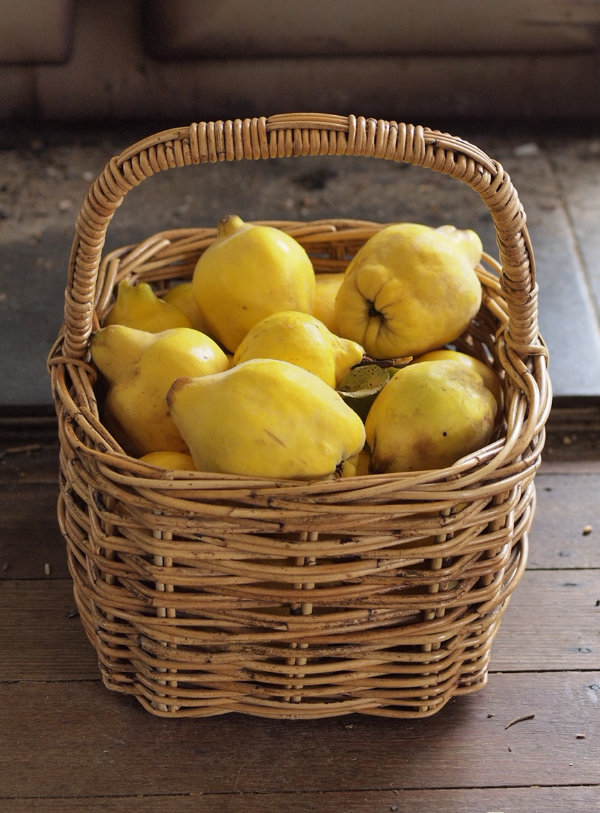
Quinces in basket

How to find quinces

If you live anywhere where apples and pears grow, you can probably find quinces. They are part of the pome fruit family, related to apples and pears. Dwarf pear trees for home gardens are actually grafted onto quince rootstock, as they are so closely related.

Quinces are ready for a brief season in mid to late autumn. There are several different varieties, and they’re usually ripe in the second and third months of autumn. Ripe quinces have yellow skin and pale flesh, which turns red or pink when cooked.

Quince can be hard to find in shops. Look for roadside fruit stands, and buckets out the front of houses with fruit trees.

How to prepare quince

Get a very big bowl or pot and put 4 litres (1 gallon) of water in it, along with 2 tablespoons cider vinegar and a teaspoon of salt. This acid water will help prevent the quinces from browning while you’re cutting up more of them.

Peel each quince and put in the acid water. Once they’re all peeled, cut the top off each one, then cut each one in half, and then in half again, to form four wedges. 

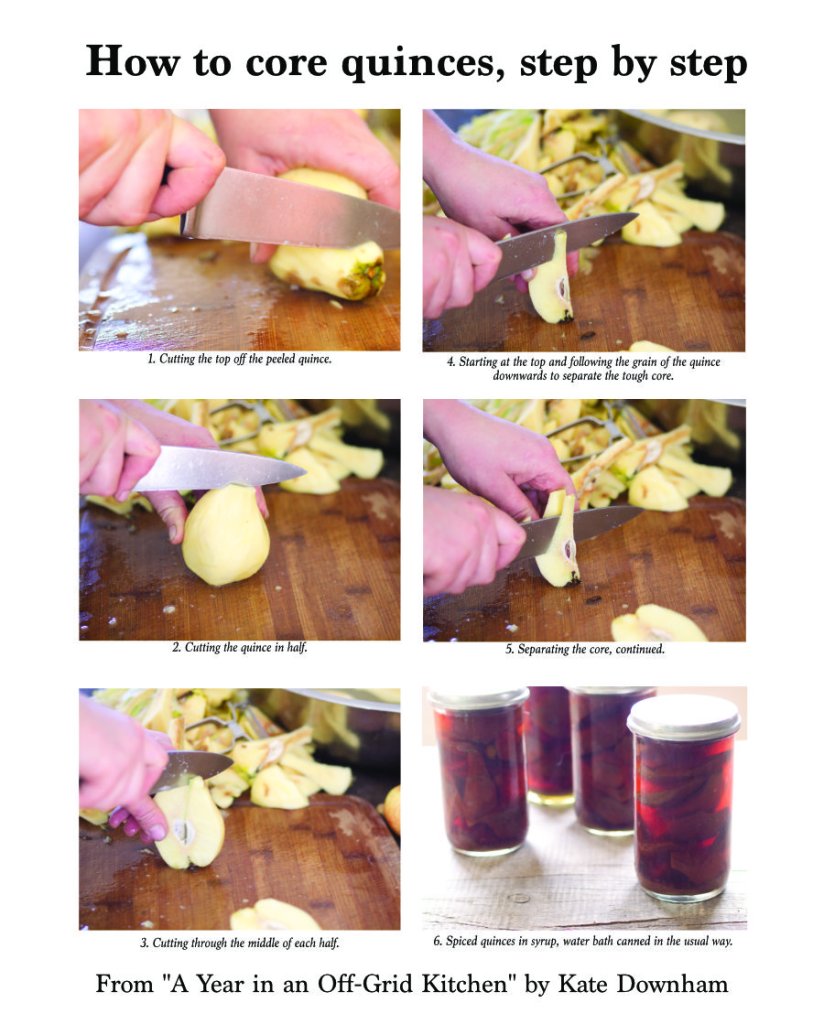
Now it’s time to remove the cores. Begin by using the knife right at the edge of the quince quarter, starting at the top, where the stem was. As you work your way downwards, allow the knife to follow the grain of the quince, so that you’re skimming along as close to the gritty and tough core as possible – this is something that is picked up over time. If you get a bit of gritty core in with the quinces, it’s not the end of the world, if you skim off too much, then that’s just some extra scraps for the goats and not for you. 

After coring, put the quince pieces back in the acid water again and leave them until you’re ready to cook. Peel and core the rest of the quinces and add them back to the acid water too. 

how to core quinces

How to cook quince in spiced syrup

In a 5 litre (5 quart) pot, prepare a syrup for poaching with 2 1/2 litres (10 cups) water, 800g coconut sugar (4 1/2 cups) or honey (2 1/3 cups), and some optional spices – I like to add 10 smashed cardamon pods, 1 cinnamon stick, and 2 star anise. Bring to a simmer on the stove and keep warm. These quantities will give enough syrup to cook between 4 and 5 kilograms (9 to 11 pounds) of quince.

Once all the quince is prepared, put them in the hot poaching liquid, adding more water and honey if it needs it. Quinces shrink a little while they’re poaching, so it’s fine to have them fit quite snugly together, but there should still be some extra syrup at first, and any extra can be used for poaching another batch of quinces, or making baked syrup dumplings, so it’s better to have too much syrup rather than not enough. 

Gently simmer over a medium-low heat for at least forty minutes, or up to a few hours if the heat is low enough. Quinces are best when they’re cooked slowly. I prefer to cook mine in the oven, as it’s a more gentle all-over heat, rather than the harsh heat that sometimes happens on top of my stove, but you can cook on a stovetop too if you keep the heat very low. 

When cooked, the quinces will be soft, and will have changed colour. They can fall apart quite easily, so handle them gently. 

Now you have a big pot full of cooked quince, ready to serve as a dessert, or add to cakes and pies. Quince in syrup can keep in the larder with the lid on for around a week, or you can put the quinces and syrup into preserving jars, seal in the usual way, and process in a boiling water bath for 40 minutes.

How to make quince jam

Quince makes a delicious jam, perfect with porridge, rice pudding, scones, pancakes, or toast. 

Ingredients

2kg (5 pounds) quinces

1 litre (quart) to 1.5 litres (1.5 quarts) water

1.2kg (2.6 pounds) honey

Method

If you don’t usually make jams, see my blog post here or my book for in depth information about the process.

Prepare quinces in the usual way by following the instructions above. Cut into very small pieces (or use a grater).

Heat 1 litre (1 quart) water in a large heavy-bottomed pot until boiling. Add the quince and stir.

Cook until the quince is very soft and can easily be mashed with a wooden spoon. As the quince cooks, it should fluff up a little and absorb water, so add water, a small amount at a time if it is needed, to form a thick sauce, keeping in mind that the honey will water it down further.

Add the honey, bring back to the boil, and continue to cook, uncovered, stirring every so often, until it passes the “plate test” (see my jam post or book for more on that)

Put your jam in jars in the usual way, Australian hot jar/hot lid/upside down works for this if this is what you normally use, or can in a boiling water bath for 10 minutes.

How to store quince

Quince can be stored for two or three months by selecting the very best, unbruised, undamaged quinces and placing them in layers in a 5 gallon bucket, with each quince surrounded by dry autumn leaves. Store in a cool place, such as an unheated room, a root cellar, or outdoors in the shade.

Quince jam and bottled quinces in spiced syrup will store for one year in a cool, dry place.

a year in an off-grid kitchen cookbook cover
For more seasonal cooking skills, tips, and recipes see my cookbook A Year in an Off-Grid Kitchen: Homestead Kitchen Skills and Real Food Recipes for Resilient Health
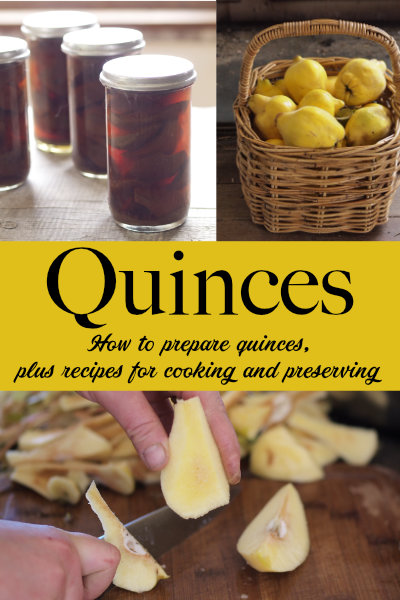
Canned quinces, quinces in basket, preparing quinces

Enter your email address here to get new recipes and blog posts from The Nourishing Hearthfire.

Introducing… A Year in an Off Grid Kitchen!

I’ve been quiet on this blog for the past few months, because I’ve been working on something very big…

I’ve been busy creating a cookbook that teaches the kitchen skills that are most important on a homestead, as well as a huge amount of adaptable everyday homestead recipes.

When the the panic buying, empty shelves, and restrictive rations hit earlier this year, it was not a problem for my family, because we knew these skills, and knew how to feed ourselves without the supermarket system. With the help of this book, you can learn these skills too.

I’ve created a Kickstarter in order to pre-sell enough copies to cover the printing costs. Running a Kickstarter means we can cut out the middleman, so I’m able to offer you a better price than the future retail one, while also being able to offer extra ebooks and other goodies.

Here’s the link to the Kickstarter: https://www.kickstarter.com/projects/706848724/real-food-cookbook-a-year-in-an-off-grid-kitchen?ref=b91p7r

There’s also an earlybird offer of extra stuff for people who back the Kickstarter in the first 48 hours, including the best natural home cleaning book I’ve read, plus documentaries on rocket ovens, hugelkultur, and more. You can find out more about the earlybird offer here: https://permies.com/t/151135/Earlybird-bundle-Grid-Kitchen-Kickstarter

Raising pigs for meat and lard

OLYMPUS DIGITAL CAMERA

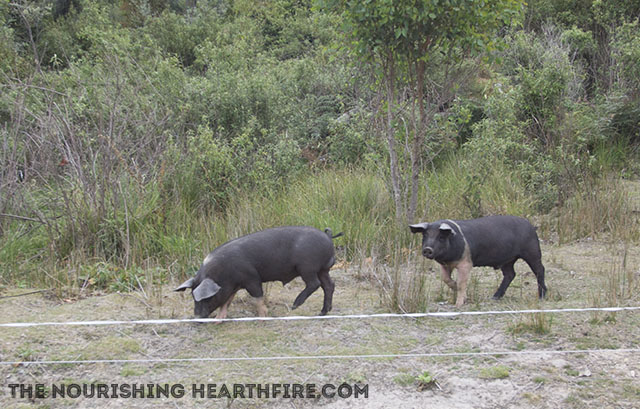
Our pigs at around 12 or 13 weeks old. Healthy Wessex saddleback boars, raised in the forest with portable electric fencing.

How much time does it take to raise pigs on the homestead for meat? How much of a commitment is it? What do you need to get started? How much does it cost?…

I write this partly for myself to read next year, so that I remember how it all works, partly for others who are considering raising pigs.

Continue reading

Cutting up a pig without a saw

how to

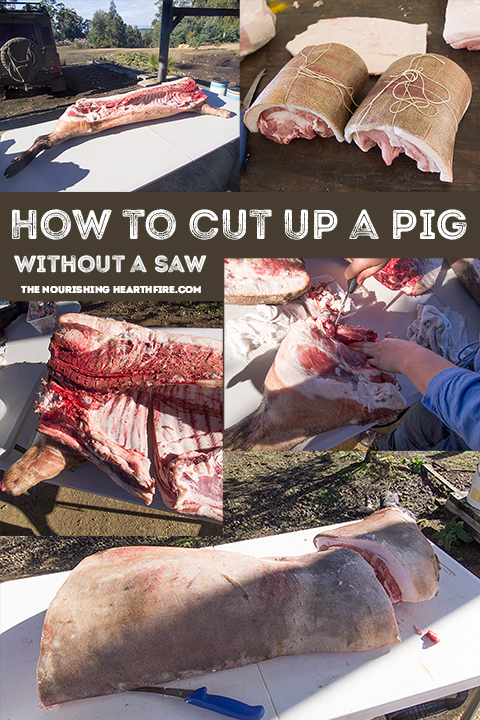
Before our pig kill (see this post) we had discussed what we wanted to do with each part of the pig. To keep costs down, we just had the mobile butcher here on one day to do the kill, hair removing, gutting, and sawing the pigs in half and leaving them to hang for a day before we would cut them up ourselves. If we wanted him to cut them into pieces he would probably have to come back another day.

We’ve never before cut pigs up ourselves, and how we handled it is a bit different to the process I’ve seen elsewhere because we didn’t have a saw. Every other instruction around is for how to do it with a saw, so I will write about how we did this using only 6” (15cm) boning knives, and maybe a firewood axe and a good aim (depending on how the spine has been cut).

Continue reading

Pig day

OLYMPUS DIGITAL CAMERA

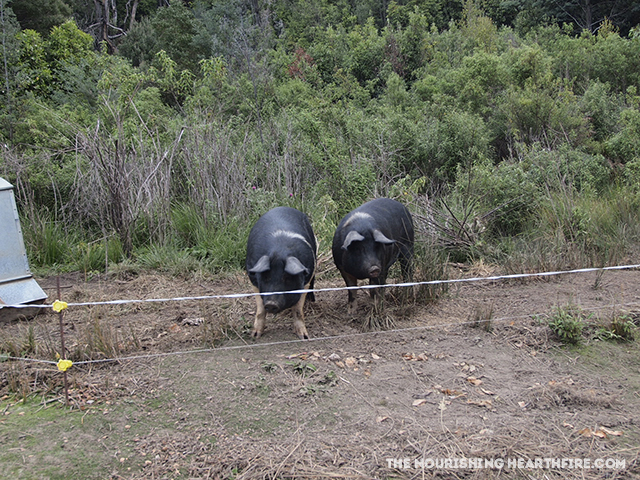
Our 6 month old Wessex saddleback boar pigs

The next few photos are of the pig slaughtering process, with commentary, to help others who want to raise their own meat or understand a process that has mostly been forgotten in modern times.

Our pigs have lived happy lives in the paddock above for the past few months. They have been able to express their pig-ness, and have enjoyed a diet of acorns, whey, scraps, and local gmo-free grains. Their natural behaviour is to search for roots in the ground with their snouts, turning over some of the soil in a gentle way, and also manuring it. They feed the soil life and prepare the ground for new plants to grow.

Vegetarians might want to stop reading this now.
Continue reading